
From Inquiry to Delivery
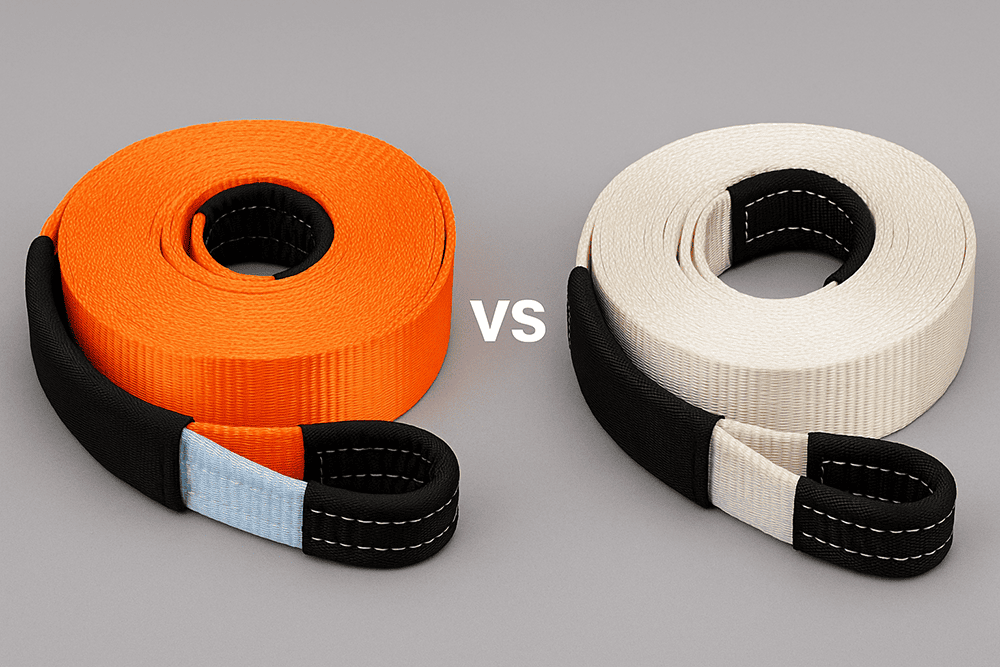
If you’ve ever been stuck in the mud, stranded in a snowbank, or caught on an off-road trail with no traction in sight, you know just how important a reliable recovery strap is. But not all straps are made the same. For B2B buyers, fleet operators, and outdoor gear brands, the question isn’t just which strap is strong—it’s which material performs best: nylon or polyester?
Nylon recovery straps offer high elasticity (up to 30%), making them ideal for dynamic vehicle recovery. Polyester straps have lower stretch (5–10%) and are better suited for controlled, static towing. Your best choice depends on how, where, and why you’re recovering a vehicle.
Let’s dive into this with a real-world example: Imagine your brand sells off-road kits to weekend warriors. Your nylon straps are a hit because they snap SUVs out of sand traps like rubber bands. But a client running a roadside towing fleet wants less stretch and more control—polyester is their answer. Now you’re starting to see: it’s not about which is best overall—it’s about which is best for the job.
A recovery strap is a tool used to recover stuck vehicles by transferring force from one vehicle to another. Material choice matters because it directly impacts stretch, strength, safety, and longevity in different towing scenarios.
Tow ropes are designed for steady, static pulls (like dragging a broken-down car), while recovery straps are made for dynamic jerks—slingshot-style rescues. Recovery straps typically use materials like nylon that stretch and recoil, absorbing shock and reducing damage.
The strap’s material isn’t just about preference. Nylon’s stretch helps absorb shock loads, reducing the risk of snapping. Polyester is more rigid, providing predictable, linear tension. For safety-critical jobs like highway towing, this predictability is invaluable.
For example, a 3-inch-wide nylon strap rated at 30,000 lbs behaves very differently under strain than a polyester strap with the same rating. The elasticity can be a safety asset—or a hazard—depending on how it’s used.
Nylon straps stretch more (20–30%) and absorb energy, ideal for off-road recoveries. Polyester straps stretch less (5–10%) and offer greater control, suitable for steady towing and winching operations.
Nylon and polyester may look similar at first glance, but their performance characteristics differ significantly—especially when it comes to vehicle recovery. Nylon is valued for its ability to stretch and rebound, which absorbs shock during high-tension recoveries. Polyester, on the other hand, provides minimal give, making it better suited for static towing where precise control is required.
| Feature | Nylon Straps | Polyester Straps |
|---|---|---|
| Stretch | High (20–30%) | Low (5–10%) |
| Water Absorption | Moderate to High | Low |
| UV Resistance | Moderate | High |
| Abrasion Resistance | Good | Very Good |
| Best Use | Dynamic recovery | Static towing |
| Safety Profile | Shock-absorbing | Controlled tension |
Nylon is inherently more flexible, with a stretch rate between 20–30%. This makes it perfect for dynamic recoveries where kinetic energy transfer is key. However, this same elasticity can be a disadvantage in situations that require more control, as it may result in unpredictable rebounds.
Polyester has a lower stretch rate—usually 5–10%—which makes it a go-to option for static towing, winching, and scenarios where linear tension is required. It offers consistent performance even in wet or UV-exposed environments.
Moreover, nylon tends to absorb more water, which can lead to temporary weakening and longer drying times. Polyester’s water resistance makes it particularly suitable for marine applications or rainy environments.
Another key difference lies in handling characteristics. Nylon is more pliable and easier to coil, but polyester has better abrasion resistance, which reduces wear and tear when the strap rubs against rough surfaces.
Polyester resists UV rays better, making it a better long-term choice for exposed environments. Nylon breaks down faster under sun and moisture unless properly treated.
Nylon straps are preferred for off-roading because their high stretch allows for dynamic recoveries, reducing shock to both vehicles during extraction.
In sand, mud, or snow, traction is low and sudden movement is key. Nylon’s stretch allows one vehicle to build momentum before the strap engages, making recovery smoother and safer.
A 4×4 club in Utah tested 10 recoveries in loose sand using both strap types. Nylon reduced recovery time by 22% and resulted in fewer jerks or strap failures.
If you’re winching a vehicle slowly up a hill or pulling it across a flat surface, polyester’s firm tension might offer better control.
Choose based on your vehicle weight, terrain, towing scenario, and load rating requirements. There’s no one-size-fits-all solution.
| Vehicle Type | Recommended Strap | Breaking Strength |
|---|---|---|
| ATV / UTV | 1″ Nylon | 7,000–10,000 lbs |
| Mid-Size SUV | 2″ Nylon | 20,000–25,000 lbs |
| Full-Size Truck | 3″ Nylon or Polyester | 30,000–35,000 lbs |
| Commercial Towing | 4″ Polyester | 40,000–50,000+ lbs |
Buying the right strap isn’t just about weight—it’s about matching the entire scenario to the right combination of features.
Nylon straps are safer for dynamic recoveries because they stretch and absorb energy. Polyester is safer for controlled static towing due to low recoil risk.
On average, nylon recovery straps can stretch up to 30% of their original length. This helps reduce sudden jolts and protects both vehicles and passengers.
Check for fraying, melted fibers, and stitching integrity. Replace straps every 2–3 years in high-use environments.
Polyester straps generally last longer due to better UV and moisture resistance, especially in outdoor or marine environments.
A 2023 internal test by Szoneier showed that untreated nylon straps lost 20% tensile strength after 6 months of outdoor storage, while polyester straps lost just 8%.
In low-moisture, temperature-stable settings with proper maintenance, nylon can match or exceed polyester’s durability.
For brands and B2B clients, OEM/ODM recovery straps offer customization, scalability, and branding advantages without the burden of in-house production.
Whether you’re a startup brand or a large distributor, choosing a factory with flexible order quantities gives you the edge.
If your end-users face off-road recovery scenarios, go with nylon. If your clients tow vehicles day-in and day-out, polyester offers control and long-term durability.
Szoneier offers both nylon and polyester recovery straps with full OEM/ODM customization. We understand the diverse needs of B2B clients across towing, off-road, and emergency markets. With over 18 years of webbing manufacturing experience, we ensure that every strap meets performance, safety, and branding requirements.
Looking to create your own custom recovery straps? Reach out to Szoneier today and let us help you build the ideal product for your customers and your brand.
Nylon straps are preferred for off-roading because their high stretch allows for dynamic recoveries, reducing shock to both vehicles during extraction.


No worries, please contact us and we will answer all the questions you have during the whole process of webbing customization.
If you have your own artwork, logo design files, or just an idea,please provide details about your project requirements, including preferred fabric, color, and customization options,we’re excited to assist you in bringing your bespoke bag designs to life through our sample production process.

Copyright ©2021 Szoneier , All rights reserved.
Looking for premium custom webbing? Contact us now for competitive pricing, free samples, and expert consultation. Fill out the form below, and our team will get back to you within 24 hours!
