- (+86)13823134897
- info@szoneierwebbing.com
From Inquiry to Delivery
 Skip to content
 From Inquiry to Delivery
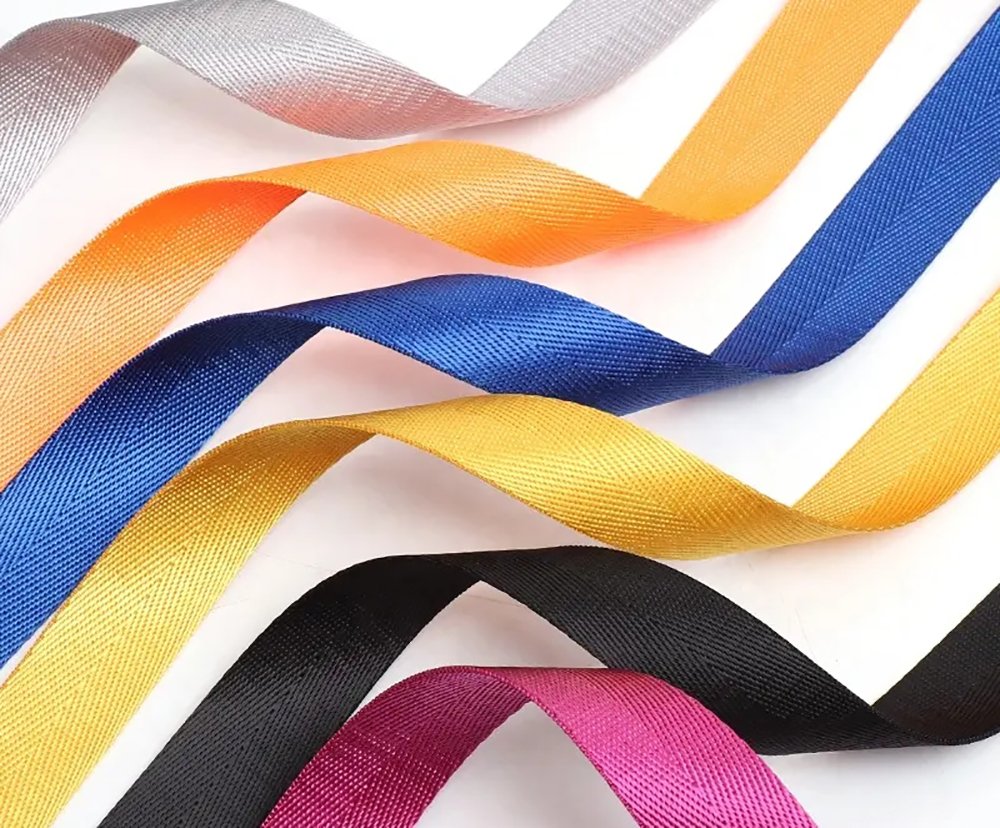
Picture this: you’ve fastened your kayak to the roof rack with what seemed like rock-solid straps. The next morning, you step outside—and your kayak is sitting a good inch lower than you left it. Cue panic. That unwanted “give” isn’t magic—it’s physics. Nylon webbing stretches both immediately under load and slowly over time. Knowing exactly how much, why, and what you can do about it means avoiding those saggy surprises and keeping your gear safe and snug.
Under typical working loads (10–20% of its breaking strength), nylon webbing elongates about 5–8%. At heavier loads (50–75%), it can stretch 10–20%, and near its breaking point, it reaches 20–30%. Left under constant tension, it creeps 1–3% per month. Moisture, heat, weave density, and coatings all tweak these values—so spec your straps wisely.
Nylon webbing is woven from high-tenacity polyamide (PA6 or PA6,6) yarns into a flat tape, then heat-set and often coated for abrasion or UV resistance. Denier, weave density, and finishing determine its strength and stretch behavior.
Nylon 6,6 (PA6,6) and Nylon 6 (PA6) are the industry standards.
| Polymer Type | Moisture Uptake | Melting Point | Initial Stretch Impact |
|---|---|---|---|
| PA6,6 | 2% | 260 °C | Baseline |
| PA6 | 4% | 220 °C | +1% elongation when wet |
Denier indicates yarn thickness:
500 denier: Lightweight, flexible—~10% stretch at 25% load.
2,000 denier: Heavy-duty—~6% stretch at 25% load.
Higher denier → thicker fibers → less elongation under same load.
Weave interlaces warp and weft yarns:
Post-weave, webbing passes through ovens at 150–180 °C for 20–30 minutes. Heat-setting:
Thin layers (~0.05 mm) of PU or silicone:
Yes. Nylon webbing shows “elastic stretch” under load (5–8%) and “creep” (1–3% permanent lengthening per month) if left taut. Rubbing, moisture cycles, and UV exposure accelerate these changes.
| Load Level | Elastic Stretch (%) | Monthly Creep (%) |
|---|---|---|
| 15% | 5–6 | 1 |
| 50% | 12–15 | 2 |
| 75% | 18–20 | 3 |
Continuous friction against buckles or pulleys abrades individual fibers:
While nylon tends to stretch under tension, heat washing (above 80 °C) without tension can cause up to 3–5% shrinkage—undesirable if straps get hot in washing machines.
| Condition | Change (%) | Nature |
|---|---|---|
| Heat-wash (no load) | –3 to –5 | Shrinkage |
| Constant load (20% stress) | +1–3/mo | Creep |
Typical service life for outdoor gear: 3–5 years, depending on use frequency, storage conditions, and maintenance. Industrial slings with annual inspections can last up to 10 years when creep stays under 5%.
At light loads (10%), nylon webbing stretches 3–5%; at moderate loads (25–50%), it stretches 5–15%; heavy loads (75–100%) yield 15–30% elongation before failure.
Nylon exhibits a non-linear stress-strain curve:
| % of Breaking Strength | Elongation (%) | Typical Application |
|---|---|---|
| 10% | 3–5 | Pet leash, light slings |
| 25% | 5–8 | Kayak tie-downs, light cargo straps |
| 50% | 10–15 | Motorcycle straps, mid-duty slings |
| 75% | 18–20 | Heavy lifting slings |
| 100% | 20–30 | Ultimate tensile tests |
Denier, weave density, heat-setting, moisture, temperature, and hardware geometry all impact stretch. Even installation techniques and use-case scenarios can add or subtract a few percentage points of elongation.
Thicker yarns resist deformation.
| Scenario | Working Load (% break) | Stretch Concern |
|---|---|---|
| Pet Leashes | 10–15 | Bounce/resistance feel |
| Cargo Tie-Downs | 25–50 | Load shifting |
| Safety Harnesses | <5 | Absolute minimal give |
| Marine Rigging | 20–40 | UV & moisture factors |
Pre-loading, industrial heat-setting, PU/silicone coating, composite layering, and proper hardware choice each cut unwanted stretch by 1–3%. Combined, you can halve overall elongation and extend service life significantly.
| Mitigation Method | Stretch Reduction (%) | Implementation Notes |
|---|---|---|
| Pre-Load Conditioning | 2–3 | Hang at 20% WL for 24 h; fibers settle |
| Factory Heat-Setting | 30% less creep | Ovens at 150 °C for 30 min; locked fiber structure |
| PU/Silicone Coating | 1–2 | Thicker coat for marine gear |
| Composite Layering | 40 total | Nylon core + polyester overlay |
| Proper Hardware Design | 2–3 | Large radius pulleys, rolled edges |
| Regular Inspections | N/A | Replace if permanent set >5% |
Polyester (2–5% stretch), polypropylene (3–6%), Kevlar® and Dyneema® (<1%) offer progressively lower stretch at higher cost. Choose based on budget, UV resistance, floatation, and flexibility requirements.
| Material | Stretch (%) | Strength (lbs) | UV/Moisture Resistance | Cost Index | Typical Uses |
|---|---|---|---|---|---|
| Nylon | 5–20 | 1,500–15,000 | Moderate | 1× | General-purpose straps |
| Polyester | 2–5 | 1,200–12,000 | Excellent | 0.9× | Marine, outdoor, awnings |
| Polypropylene | 3–6 | 800–8,000 | Good (floats) | 0.8× | Water sports, chemical-resistant |
| Kevlar® | <1 | 2,000–20,000 | Excellent | 3× | Ballistic gear, aerospace |
| Dyneema® | <1 | 3,000–25,000 | Excellent | 4× | Rescue slings, high-performance rigging |
Use a field rig with known weights and marked scale for quick checks, or lab tensile tests per ASTM D677 for precise stress-strain curves. Record initial length, load, elongation, and permanent set after unloading.
Equipment: Calibrated tensile tester, controlled speed (300 mm/min).
Protocol:
Precision: ±0.1 mm.
| Test Method | Load Levels | Accuracy | Cost Estimate |
|---|---|---|---|
| DIY Rig | 10–50% | ±0.5 mm | <$100 |
| ASTM D677 Lab Test | 5–100% | ±0.1 mm | $200–$500/test |
Stretch happens—but now you know exactly why nylon webbing stretches, how much to expect, and how to control it. From polymer choice and weave density to pre-load conditioning and lab testing, every step helps you keep straps tight and reliable.
Ready to get custom-engineered webbing that behaves exactly the way you need? Szoneier offers:

No worries, please contact us and we will answer all the questions you have during the whole process of webbing customization.
If you have your own artwork, logo design files, or just an idea,please provide details about your project requirements, including preferred fabric, color, and customization options,we’re excited to assist you in bringing your bespoke bag designs to life through our sample production process.
Copyright ©2021 Szoneier , All rights reserved.
Looking for premium custom webbing? Contact us now for competitive pricing, free samples, and expert consultation. Fill out the form below, and our team will get back to you within 24 hours!
 Optimized by Seraphinite Accelerator